Ask ten creators what a hook is and you'll get ten versions of the same half-answer: "the thing at the start that grabs attention." True, and useless. Because the opening of a video is not one thing. It is three separate tools doing three separate jobs, usually within the same ten seconds:
- The hook is what you say. It makes a promise.
- The visual hook is what the viewer sees. It earns the pause before a single word lands.
- The Super Hook is who you are. It converts curiosity into trust.
When creators say "my hook was good but the video flopped," the problem is almost always one of the other two. This post breaks down what each tool does, how they stack, and which one to lead with for your format.
And since this post is about to argue that credibility beats claims, here's mine: last week I was on set producing broadcast and social spots for LegalZoom, a company that spends over $100 million a year on media. Every single thing we shot opened with either a visual hook or a written one, and we shot a lot of them, because at that spend level nobody guesses which opening works. You shoot the variants and let the testing decide. That paragraph, by the way, was this article's Super Hook. Notice what it just did.
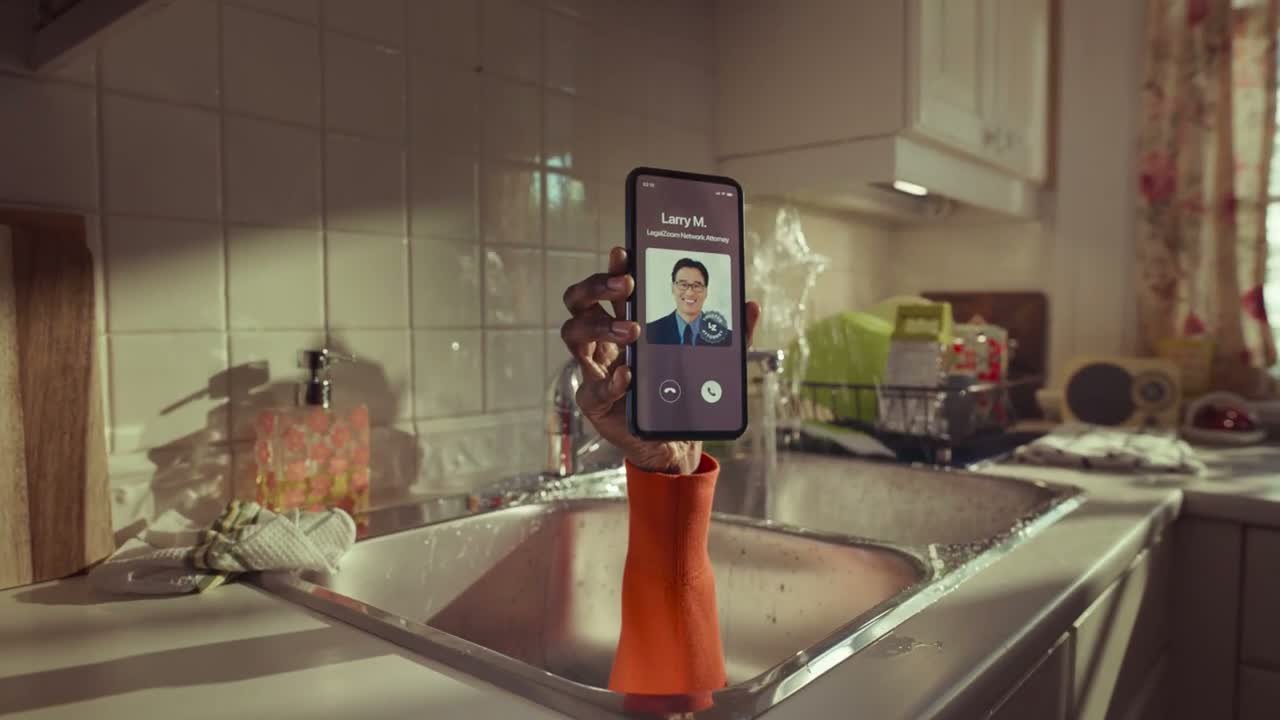
The Hook: The Promise (Seconds 0 to 3)
The hook is the opening line, spoken or written, that tells the viewer why the next thirty seconds are worth their time. It stops the scroll by opening a loop the viewer needs closed.
The classic shapes:
- Curiosity gap: "Your best-performing video broke a rule you didn't know existed."
- Bold claim: "Every viral video you have ever seen uses this one structure."
- Direct callout: "If your videos die at three seconds, this is why."
- Stakes up front: "I almost lost my channel over this setting."
Its job: attention. Its failure mode: the scroll. If the first line is throat-clearing ("hey guys, welcome back"), the video is over before it starts.
A hook is a promise, and that matters for everything downstream: the rest of the video is either keeping that promise or breaking it. Which is exactly where the second tool comes in.
The Visual Hook: The Frame (Second 0, Before the Sound)
Here is the uncomfortable truth about your spoken hook: a large share of your audience never hears it. Feeds autoplay muted. Viewers decide on the first frame, not the first sentence. The visual hook is whatever is on screen in that first moment that makes the eye stay.
Visual hooks come in a few reliable flavors:
- Motion: something already mid-action on frame one. A pour, a reveal, a fall, a hand reaching in. Starting mid-move beats starting at rest, every time.
- The unusual: a scene the brain can't file instantly. An odd object, an unexpected location, a wrong-scale prop.
- The satisfying: texture, symmetry, transformation. The reason cleaning videos and pressure washing exist as genres.
- Text on screen: your spoken hook, written. For sound-off viewers, the caption IS the hook.
- A face, close and expressive: humans lock onto faces. An emotional expression is a visual hook all by itself.
Its job: earn the pause in a muted feed. Its failure mode: a static, generic first frame. A talking head sitting still in a chair is the visual equivalent of "hey guys, welcome back."
Want to watch the fifth flavor overpower everything else on this list? UGC creator @ugc.withrach posted a reel breaking down why videos underperform. The spoken-hook advice is genuinely solid: rewrite your first line, test different angles, interrupt the pattern. Then look at the top comment. Twelve thousand likes: "Girl your face is the hook."
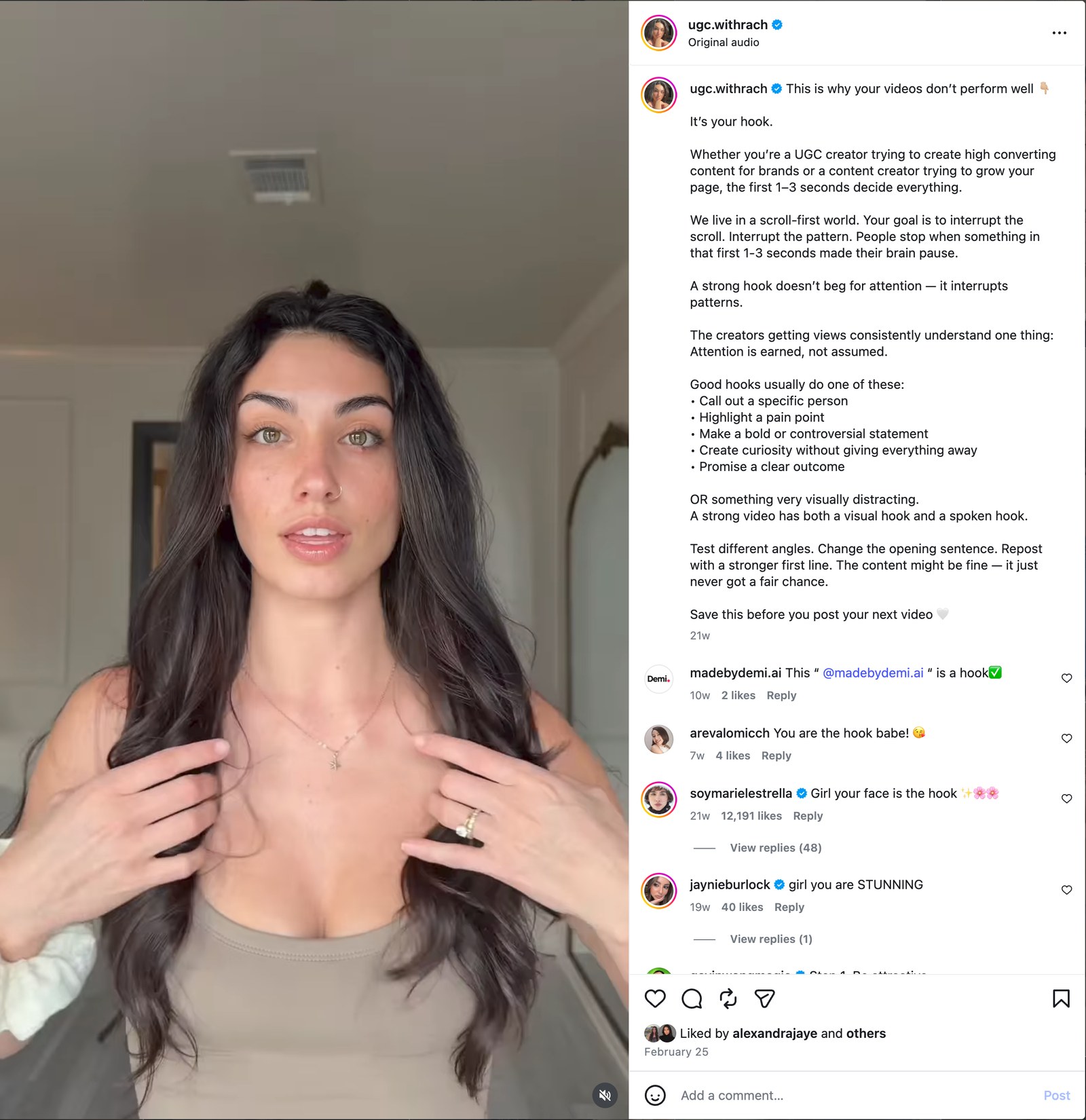
The audience isn't wrong, and neither is she. Her own caption concedes that a strong video needs both a visual hook and a spoken one. An expressive face, close to camera, mid-gesture, won the pause before a single word of her advice got processed. The lesson isn't that you need to look like her. It's that the frame argues first, whoever you are: energy, expression, and proximity to the lens are visual hooks available to any creator willing to get close and stay animated.
One rule ties the visual hook to the spoken one: they have to be about the same promise. A shocking visual that has nothing to do with your actual content buys you three seconds and then costs you the viewer, the completion rate, and a little bit of trust in your next video. The algorithm notices all three.
The Super Hook: The Receipts (Seconds 3 to 10)
You stopped the scroll. The viewer is listening. Now they are silently asking one question: "Why should I listen to you?"
The Super Hook is the credibility statement that answers it, placed immediately after the hook. We wrote a full breakdown of the concept here, built on Chris Chung's framework, but the short version is that Super Hooks come in three types:
- Money: "I've managed over $21.7 million in content ad spend."
- Effort: "I analyzed 500 viral videos over six months."
- Scale: "I've pulled over a billion views on short-form video."
Its job: trust. The hook makes a promise; the Super Hook is the reason to believe you can keep it. Its failure mode: the half-engaged viewer who watches your list of tips one thumb-flick away from leaving, because nothing told them your list is different from the five hundred others making the same claim.
Not every video needs one. Entertainment doesn't need credentials. But the moment you are teaching, recommending, or selling, the Super Hook is the difference between being watched and being believed.
How They Stack: One Opening, Three Layers
These aren't three alternative openings you choose between. They are three layers of the same opening, hitting in sequence:
Frame 1: the visual hook earns the pause.
Seconds 0 to 3: the hook makes the promise.
Seconds 3 to 10: the Super Hook earns belief.
Then: the value delivers the promise, and the CTA collects.
Look at any high-performing educational video and you'll find all three, usually integrated so smoothly you don't notice them as separate moves. The frame is already moving, the first sentence opens a loop, the second sentence shows receipts, and by second ten you're committed.
When to Use Which: A Format Guide
Talking-head educational content
All three, every time. Lead visual: you, mid-gesture or mid-demonstration, never settling into frame. Spoken hook with on-screen text mirroring it. Super Hook within the first ten seconds. This is the full stack, and education is where it pays most.
Faceless and b-roll formats
The visual hook leads and carries. Your spoken hook becomes bold text on screen over the strongest visual you have. The Super Hook still exists, but it moves into the voiceover or the caption: "I tested 14 of these so you don't have to." Faceless doesn't mean credibility-less.
Product and ad creative
Visual hook first: product mid-transformation, result mid-reveal. The hook is the offer clarity, the value proposition landing inside five seconds. The Super Hook becomes social proof: review counts, customers served, before-and-after receipts. In paid feeds the competition is every other ad, so the visual bar is higher and the promise has to land faster.
Entertainment and storytime
Hook and visual hook do the work. The Super Hook is optional and usually replaced by stakes: "and that's when I realized whose car it was" doesn't need a resume behind it. Credentials can actually slow a story down. Skip them unless the story IS your expertise.
Podcast clips and interviews
Start mid-sentence at the most charged moment: that is the hook. Captions carry it for muted feeds. The visual hook is the speaker's energy, so pick the clip where the body language spikes. The Super Hook is the guest intro line, one sentence, layered as text: "Fired from Google. Built a $40M company."
The Mistakes That Kill Openings
- Credentials before curiosity. Leading with your Super Hook ("Hi, I'm a 7-figure marketer...") before making any promise gives the viewer nothing to care about. Promise first, proof second. Always in that order.
- The bait visual. A visual hook that has nothing to do with the content. You win the pause and lose the viewer, and your completion rate tells the algorithm exactly what happened.
- The Super Hook novel. One sentence. Two at most. "I spent six months testing this" is a Super Hook; your career history is a LinkedIn profile.
- A frozen first frame. If nothing moves in the first two seconds, the muted-feed viewer is gone before your hook even exists for them.
- Treating the three as interchangeable. A great spoken hook can't rescue a dead frame. A gorgeous visual can't rescue a promise nobody believes. Each layer covers a failure mode the others can't.
The Three-Question Decision Guide
Before you shoot the opening, ask:
- Will my audience hear this or read this? Muted feeds mean the visual hook and on-screen text lead. Sound-on contexts let the spoken hook lead.
- Am I asking for attention or for trust? Entertainment needs attention: hook plus visual. Education and selling need trust: add the Super Hook.
- Does my promise need proof? The bigger the claim in your hook, the harder the Super Hook has to work. "I like this app" needs no receipts. "This app made me $30K" does.
Three tools. Three jobs. The word "hook" was hiding all of this inside one syllable, and now you can stop guessing which one your video is missing.
Already Posted? The Retention Graph Names the Culprit
The decision guide works before you shoot. After you post, your analytics run the same diagnosis in reverse: the timestamp where viewers leave points at the layer that failed.

- Dies at 0 to 1 seconds: they never heard you. That's a visual problem. The line might be great, but the frame said skip. Fix the first frame, not the script.
- Dies at 2 to 4 seconds: they paused, listened, and left anyway. The promise didn't land. That's the hook. Try a different archetype, more specificity, a tighter loop.
- Dies at 5 to 10 seconds: they were curious, but nothing made them believe you. That's the Super Hook slot sitting empty: curiosity that never converted into trust. Add the receipts.
- Bleeds out slowly after 10: the opening did its job and the video broke the promise. No hook fixes a delivery problem.
Same three layers going in. Three timestamps coming out.
FAQ: Hooks, Super Hooks, and Visual Hooks
What's the difference between a hook and a Super Hook?
The hook is the opening line that stops the scroll by making a promise in the first three seconds. The Super Hook is the credibility statement placed right after it, answering why the viewer should listen to you. Attention first, trust second.
What is a visual hook?
Whatever is on screen in the first frame that makes the eye stay: motion already in progress, an unusual or satisfying image, bold text, an expressive face. Most feeds autoplay muted, so many viewers decide on the frame before hearing a word.
Do I need all three in every video?
Hook and visual hook: yes, every video, every platform. The Super Hook only when you're asking for trust: teaching, recommending, or selling. Pure entertainment runs on stakes, not credentials.
Should my on-screen text just repeat my spoken hook?
In a muted feed, yes: the caption is how sound-off viewers receive the promise, so mirroring the hook there is a feature, not a redundancy. The layer where text can add something new is the Super Hook: a one-line credential on screen while your voice carries the story.
How long should a Super Hook be?
One sentence. Two at the absolute limit. Specific beats long: "I tested 14 of these so you don't have to" does more work than a paragraph of biography.
What if I don't have impressive numbers yet?
Use the Effort type. Time invested is a credential anyone can earn: hours researched, videos analyzed, days tested. You did the work so the viewer doesn't have to. That's trust with no follower count required.
Engineer All Three
ScriptHooks generates hooks and Super Hook pairings from a database of 5,000+ tagged viral openings, and the Video Grader scores your first three seconds before you post.
Generate Your Hooks →
ScriptHooks is a growing database of 5,000+ viral video hooks, updated daily. Built for creators and teams that want to stop guessing and start engineering their openings.
Try it free →
Go make something that stops the scroll.
Wes