If you've spent any time studying short-form content, you've heard it a thousand times: the hook is the most important part of your video.
They're half right.
The hook gets the scroll to stop. But stopping the scroll and keeping the viewer are two different jobs. There's a second move — one that happens in the seconds immediately after the hook — that separates videos that get views from videos that get results. Attention from trust. Impressions from conversions.
It's called a Super Hook. And if you're not using one, your best hooks are doing half the work they could.
What Is a Super Hook?
A Super Hook is the credibility statement that comes right after your opening hook. It answers the one question every viewer is asking — consciously or not — before they commit to watching your video:
"Why should I listen to you?"
Here's the difference:
A hook stops the scroll. It creates curiosity, makes a bold claim, or interrupts a pattern. It earns you the first three seconds.
A Super Hook earns you the next thirty. It immediately establishes why you're the person who can deliver on the promise the hook just made.
The concept comes from Chris Chung (@iamchrischung), who's managed over $21.7 million in content ad spend and works behind the scenes with entrepreneurs who collectively have over 87 million followers.
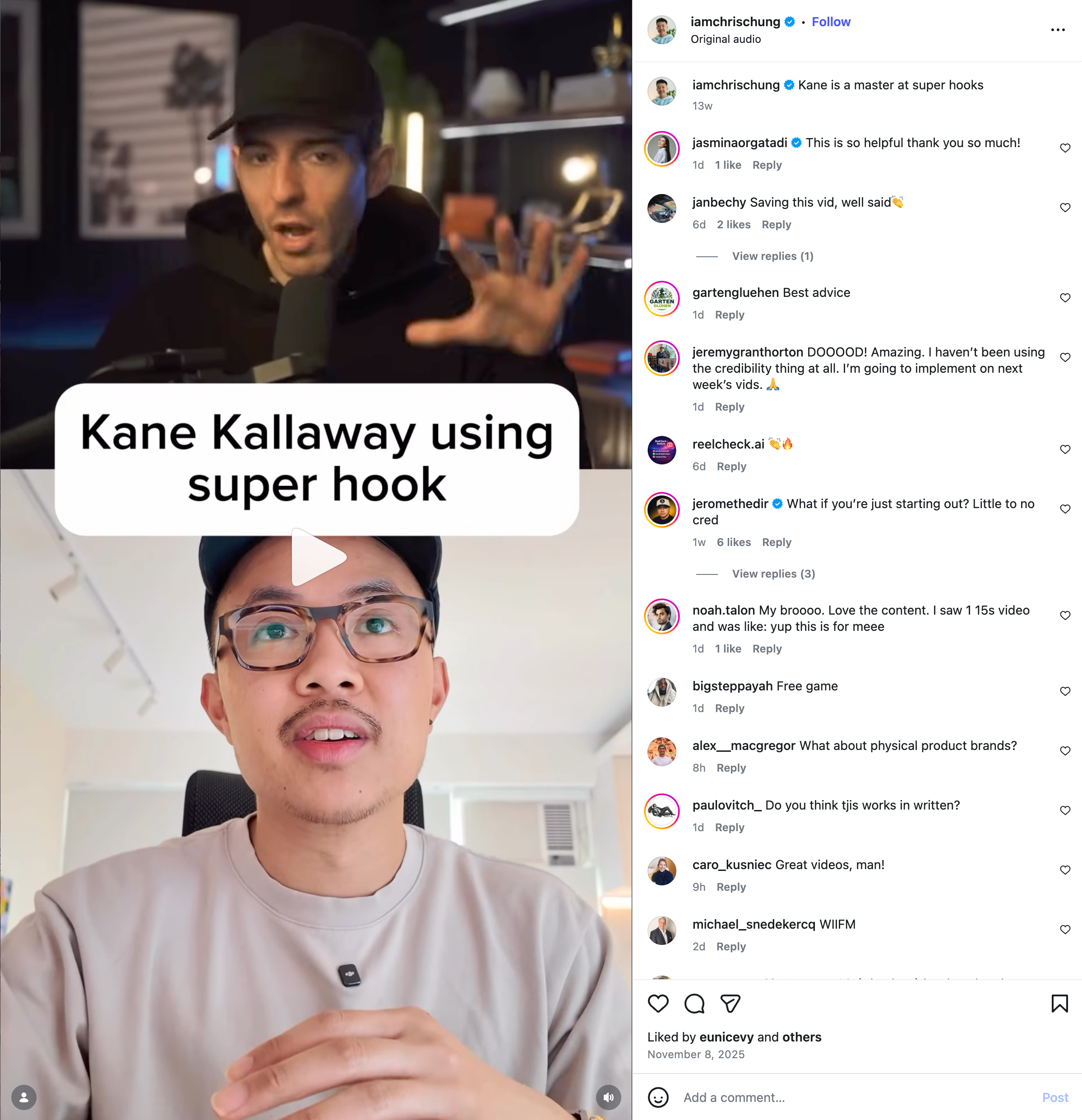
In his words:
"A Super Hook needs to answer for the viewer: why should I listen to you? And it's far more important than what you just say in your first line — because if you create educational videos, you want to instantly demonstrate credibility."
He goes further:
"Super Hooks don't always have to be about money. It can also be with time or effort. If you start using Super Hooks in all your videos, I guarantee you'll see at least a 20% increase in conversions."
What comes after is the Super Hook. And it changes everything.
The Anatomy of a Super Hook
Let's look at a real example from content strategist Callaway, as featured in Chung's breakdown:
Hook: "Today we're talking about storytelling. If you want your content to perform better, you need to learn how to tell better stories. Every online content guru will tell you that the hook is the most important part, but no one teaches you what comes after. Watch this."
Super Hook: "By the way, I'm Callaway. I've pulled over a billion views on short-form video. I've got 500,000 followers, and I think about this stuff all the time."
The hook creates interest — "nobody teaches you what comes after" is a textbook curiosity gap. But the Super Hook is what makes you stay. A billion views. 500K followers. This person clearly knows what they're talking about. You're no longer watching out of curiosity. You're watching because you trust the source.
That shift — from curious to committed — is where conversions happen.
Why Super Hooks Work
Think about what happens without one.
You open with a great hook: "Three things every viral video has that nobody talks about." The viewer pauses. Interesting. But then you just... start listing things. The viewer has no reason to believe your list is better than the 500 other videos making the same claim. They might watch. They might not. And even if they do, they're half-engaged — one thumb-flick away from the next video.
Now add a Super Hook: "I've managed over $21.7 million in content ads and work behind the scenes with entrepreneurs who now collectively have over 87 million followers."
Suddenly the list that follows isn't generic advice. It's field-tested intelligence from someone with receipts. The viewer leans in. They watch longer. They're more likely to follow, save, or take the action you ask for at the end.
This is why Chung claims that adding Super Hooks to your videos can drive at least a 20% increase in conversions. The hook gets attention. The Super Hook converts that attention into trust. And trust is what drives action.
The Three Types of Super Hooks
Super Hooks don't always look the same. But they all accomplish the same thing: instant credibility. Here are the three forms they take.
1. The Money Super Hook
Establish credibility through financial results — yours or your clients'.
- "I've managed over $21.7 million in content ad spend"
- "That's one of the biggest reasons we had a $105 million launch in 72 hours"
- "This one mistake cost me $47,000"
Why it works: Money is specific, concrete, and universally understood. It instantly signals that you're operating at a level worth listening to. The specificity matters — "$21.7 million" hits harder than "millions of dollars" because it sounds real, not inflated.
2. The Effort Super Hook
Establish credibility through time, research, or work invested.
- "I spent three days listening to all the top interviews on how to run faster. Here are the three biggest lessons I learned."
- "I analyzed 500 viral videos over six months"
- "After 13 years of using this one strategy repeatedly"
Why it works: You did the work so the viewer doesn't have to. This positions you as a curator — someone who's filtered signal from noise. It's especially powerful for educational content where the viewer doesn't care about your revenue, but does care about your depth of research.
3. The Scale Super Hook
Establish credibility through audience size, reach, or volume of work.
- "I've pulled over a billion views on short-form video"
- "I work behind the scenes with entrepreneurs who collectively have over 87 million followers"
- "I've helped over 300 creators hit their first 100K"
Why it works: Scale implies pattern recognition. If you've done something at volume, you've likely learned things that someone who's done it twice hasn't. The viewer trusts that your advice is battle-tested, not theoretical.
Where to Place the Super Hook
Placement matters. The Super Hook sits in a very specific position in your video structure:
Not at the very beginning. If you lead with credentials, it feels like bragging. The hook earns you the right to establish credibility.
Not buried in the middle. By then, the viewer has already decided whether to trust you. The Super Hook needs to land in the first 5–10 seconds, right after the initial hook grabs attention.
Not as a replacement for the hook. "$21.7 million in content ads" is a great Super Hook. But it's not a great hook — it doesn't create curiosity or a reason to watch. The hook opens the door. The Super Hook makes the viewer walk through it.
The Hook + Super Hook Formula
Here's a framework you can use on your next video:
1Write Your Hook (The Scroll-Stopper)
This is the opening line that earns you the first three seconds. Use a proven archetype:
- Curiosity gap: "Three invisible things every perfect video has"
- Contrarian claim: "Why I stopped using to-do lists and got more done"
- Bold promise: "If you start using this, I guarantee a 20% increase in conversions"
- Pattern interrupt: "Watch this" + unexpected visual
2Write Your Super Hook (The Trust Builder)
Immediately after the hook, answer "why should I listen to you?" Pick one:
- Money: What financial results can you point to? Be specific.
- Effort: What research, time, or work did you invest? Quantify it.
- Scale: What reach, audience, or volume of work demonstrates your authority?
The key: be specific. "I've been in the industry for years" is not a Super Hook. "I've managed $21.7 million in content ad spend across 87 clients" is.
3Deliver Value That Pays Off Both
The rest of your video needs to live up to the promise your hook made and the credibility your Super Hook established. If your Super Hook says you've managed millions in ad spend, your advice better sound like it comes from someone who has — not from a blog post anyone could've read.
The Three Invisible Things (Bonus Framework)
While we're breaking down what makes content actually compound, here's a related framework from Chung that works hand-in-hand with the Super Hook — what he calls the three invisible things every perfect video has:
1. A Balanced TAM (Total Addressable Market)
If your video is too niche, no one watches. Too broad, no one buys. The fix: start with a hook that has broad appeal, then niche down with your value and call to action.
Hook (broad): "I did a hundred pushups a day for six months"
Value (niche): "As a new dad, that changed everything"
CTA (targeted): "New dads — here's a three-day workout I made for you"
The hook casts a wide net. The value qualifies the viewer. The CTA converts the right ones.
2. A Non-Obvious Angle
Not "three productivity hacks" — that's what Chung calls "moist content." It blends in with everything else. Instead: "Why I stopped using to-do lists and got more done in half the time." That's non-obvious. It creates tension. And then you can add real value by showing the exact system — because most people stop at the cool idea and never finish with an actual takeaway.
3. A Connection Back to Your Business
You don't need to scream "buy my course" every ten seconds. But your content should anchor back to what you actually help people with. Chung shares a case study: a client went viral with an NBA story — 7.6 million views — but none of those viewers cared about his actual offer (a coaching service), because the video wasn't connected to it. His next video, tied directly to his offer, got 50K views but filled his one-on-one coaching spots in a week.
Views without connection are vanity metrics. A Super Hook without a business anchor is just impressive bragging.
The Third-Second X-Factor
One more technique from Chung worth noting: the third-second X-factor.
Across the viral videos he's analyzed, a disproportionate number have something unexpected happen specifically at the third second — a visual surprise, an audio shift, a sudden reveal. A fan opens. Someone spins. A Rolls Royce appears. A person starts singing unexpectedly.
It's a pattern interrupt timed to the exact moment most viewers are deciding whether to stay or swipe. The algorithm rewards retention, and a well-placed surprise at second three is often enough to push a viewer past the decision point.
This is the visual complement to the Super Hook. The Super Hook builds trust through words. The X-factor builds retention through surprise. Used together, they're a one-two punch that locks the viewer in.
Where ScriptHooks Fits
This is exactly why we built hook archetypes and credibility tagging into the ScriptHooks database. When you search our 3,400+ proven hooks, every result is tagged with its archetype — curiosity gap, bold claim, pattern interrupt, controversy, story setup, direct benefit, social proof — along with the emotional trigger it uses.
That metadata isn't just for finding a good opening line. It's for designing the full Hook → Super Hook → Value sequence.
Search for a hook that stops the scroll. Then pair it with a Super Hook that establishes your credibility. Then build value that pays off both.
You're not looking for one hook anymore. You're looking for the opening move in a sequence that earns attention, converts it to trust, and connects it to your business.
The Bottom Line
The hook is not the most important part of your video. It's the first important part.
What comes immediately after — the Super Hook — is where trust is built, where viewers go from curious to committed, and where the real conversion happens. Without it, even the best hook in the world is leaving money on the table.
Next time you're scripting a video, don't stop at the opening line. Ask yourself: why should anyone listen to me on this topic? Then say it — with specifics, with receipts, in the first ten seconds. Money, effort, or scale. Pick one and own it.
That's the Super Hook. And it's the difference between content that gets views and content that actually compounds.
NEW: Super Hook Me — Now Built Into ScriptHooks
We've taken everything above and turned it into a one-click feature. Here's exactly how to use it.
1Enter Your Topic and Credentials
Start by entering your video topic and target audience like normal. But now there's a new field: Your Credentials.
This is where you tell the AI who you are — your experience, results, research, audience size, revenue, anything that establishes your authority. The more specific, the better.
Example: "9 years producing content, over 1,000 videos published, worked with 50+ brands"
The hook generator will use these real numbers in your hooks instead of making up stats. No more "I grew 847K followers" when you have 12K. Your hooks will reflect your actual story.
2Generate Your Hooks
Click Generate Viral Hooks (1 credit). You'll get 5 hooks tailored to your topic, and if you filled in credentials, they'll use your real numbers:
"I made 1,000 videos in 9 years, here's what actually works"
Instead of a generic hook with fabricated metrics, you get something you can actually say on camera without lying.
3Click Super Hook Me
After your hooks appear, you'll see the Super Hook Me button. Click it (3 credits).
The AI generates three Super Hook variants for every hook — one for each credibility type:
Money
Authority through financial results
Effort
Authority through time and research invested
Scale
Authority through audience and reach
4Pick the One That Fits
You don't use all three. You pick the one that best matches your actual credentials and the video you're making.
If you've never shared your revenue publicly, skip Money. If your audience is small but you've been grinding for years, pick Effort. If you've got impressive reach numbers, go with Scale.
Each variant shows the original hook paired with the Super Hook, and there's a Copy Pair button that grabs both — ready to paste into your script.
Hook: "Everyone's doing TikTok growth wrong (yes, including you)"
Effort Super Hook: "I've spent 9 years and published over 1,000 videos testing every growth strategy out there so you don't have to."
That's your opening. Hook stops the scroll. Super Hook earns the next 30 seconds. Now deliver value.
What It Costs
- Hook generation: 1 credit (5 hooks)
- Super Hook Me: 3 credits (Money + Effort + Scale variants for all 5 hooks)
- Works with brand voice personas and connected channel metrics for even deeper personalization
Try Super Hook Me
Generate hooks, add credibility statements, and copy the pair into your script.
Try It Now →
ScriptHooks is a growing database of 3,400+ viral video hooks, updated daily. Built for creators and teams that want to stop guessing and start engineering their openings.
Try it free →
Go make something that stops the scroll.
— Wes