
In the mid-1990s, Kurt Vonnegut gave a lecture that changed how many writers think about storytelling. He stood at a chalkboard, drew a simple graph, and mapped out the emotional arcs of humanity's most enduring stories.
His thesis was simple: most popular stories follow a handful of predictable shapes. Those shapes heavily influence whether an audience stays hooked or scrolls away.
Decades later, the same patterns show up in the most viral content on TikTok, YouTube, and Instagram. The medium changed. The psychology didn't.
The 8 Story Shapes
Vonnegut identified eight fundamental narrative arcs. Each one plots a character's fortune over time — from good to bad, low to high, or somewhere in between.
| Shape | Emotional Promise | Great For... |
|---|---|---|
| Man in Hole | Fall, struggle, satisfying comeback | Transformation, challenges, habits |
| Boy Meets Girl | Discovery, loss, reunion | Niche discovery, tools, frameworks |
| From Bad to Worse | Escalating dread or caution | Horror, cautionary tales, warnings |
| Which Way Is Up? | Unresolved ambiguity | Hot takes, controversial opinions |
| Creation Story | Steady uplift, accumulating value | Listicles, "X tools/tips" content |
| Old Testament | Rise then catastrophic loss (net loss) | "The mistake that ruined me" content |
| New Testament | Fall then redemption (net gain) | Founder stories, career pivots |
| Cinderella | Full emotional journey | Weight loss, rags-to-riches, breakthroughs |
Not sure which shape fits? Start with Man in Hole for most transformation content, Creation Story for tips/tools, or Cinderella for personal breakthrough stories.
1. Man in Hole
The most common shape in storytelling. A character starts in a stable place, falls into trouble, struggles, and climbs back out — ending up better than before.
Think: every comeback story, every "I was broke, now I'm not" video, every transformation reel. Or more specifically: "I tried waking up at 5am for 30 days" or "I quit sugar for 90 days."
This shape works because it mirrors how we want our own lives to go. We fall, we rise, we grow.
2. Boy Meets Girl
A character finds something wonderful, loses it, then wins it back for good.
This isn't just about romance. It's about any discovery-loss-recovery arc. A creator finds their niche, loses momentum, then breaks through bigger than before. Or: "I found the perfect note-taking system, lost it, then rediscovered a version that finally stuck."
The emotional whiplash — joy, loss, joy again — keeps audiences invested.
3. From Bad to Worse
The character starts in a tough spot and it only gets darker. No redemption. No silver lining.
This is tragedy in its purest form. Think Kafka's Metamorphosis or The Twilight Zone.
In content, this shows up in cautionary tales, "what not to do" videos, and horror storytelling. It works because it creates tension without release — and tension is attention.
4. Which Way Is Up?
The story has a lifelike ambiguity. We can't tell if developments are good or bad.
Vonnegut pointed to Hamlet as the prime example. Things happen, but their meaning stays uncertain.
This shape is harder to pull off in short-form, but it's powerful for content that provokes thought over emotion. Hot takes, controversial opinions, "let me challenge your assumptions" videos. These stories often end without a neat lesson, leaving the audience to decide what it all means.
5. Creation Story
Incremental gifts, one after another. The line only goes up.
This is the shape of many cultures' origin myths — humanity receives gift after gift from a higher power.
In content, this is the listicle. "5 tools that changed my life." "10 things I wish I knew sooner." Each point is a gift to the viewer.
6. Old Testament
Gifts come, then a sudden, catastrophic fall.
The audience receives value, then watches it all collapse. The fall feels earned because we saw what was lost.
This shape drives "the mistake that cost me everything" content. The crash only hits hard if we first saw the climb.
Key distinction: This shape ends in a net loss.
7. New Testament
Gifts, then a fall, then redemption beyond what was lost.
This is Old Testament with a resurrection. The low point isn't the end — it's the setup for an even higher high.
This is the shape of the most compelling founder stories, weight loss journeys, and career pivots. Rock bottom becomes the launchpad.
Key distinction: This shape ends in a net gain that exceeds everything before.
8. Cinderella
Vonnegut noted this shape mirrors the New Testament arc almost exactly. A character starts low, receives incremental blessings, suffers a setback, then achieves a finale that exceeds everything before.
It's the most emotionally satisfying shape because it combines struggle, loss, and triumph. The audience gets the full ride.
Why This Matters for Short-Form Video
Here's what Vonnegut understood that most creators miss: audiences don't engage with information. They engage with emotional movement.
A video that stays flat — all value, no arc — feels like a lecture. Even if the information is good, flat emotional tone kills retention. A video that moves through an emotional shape feels like a story, even if it's only 60 seconds long.
The hook is where the shape begins. The first three seconds tell the audience which ride they're on:
- "I lost everything at 25" → Man in Hole (stable → fall → climb back)
- "This one mistake cost me my business" → Old Testament (rise → catastrophic loss)
- "3 tools that 10x'd my productivity" → Creation Story (gift → gift → gift)
- "Everyone told me I was wrong. Here's what happened." → Cinderella (low → gifts → setback → triumph)
The shape you choose determines the hook you need.
How We Built This Into ScriptHooks
After spotting these patterns in our top-performing videos, we baked them directly into our Script Generator.
We've studied thousands of viral videos — over 5,000 hooks from content with 100K to billions of views. And one pattern kept emerging: the highest-performing scripts don't just have good hooks. They have clear emotional shapes. But here's the thing — different content types need different arcs.
A UGC creator needs to hook and hold attention. A commercial needs to move viewers from skeptical to convinced. An educational video needs to take someone from confused to clear. So we built custom story arcs for every script type.
What's New
- 12 script types, each with its own arc — UGC gets an Engagement Arc. Commercials get a Persuasion Arc. Fiction still uses Vonnegut's classic shapes.
- Custom emotional scales per type — Comedy tracks from "Flat" to "Funny." Horror tracks from "Calm" to "Terrifying." Educational content tracks from "Confused" to "Clear."
- Visual beat mapping — See exactly where your script's highs and lows land, so you can pace the emotional journey intentionally.
- Structure breakdowns — Every arc comes with numbered story beats specific to that format.
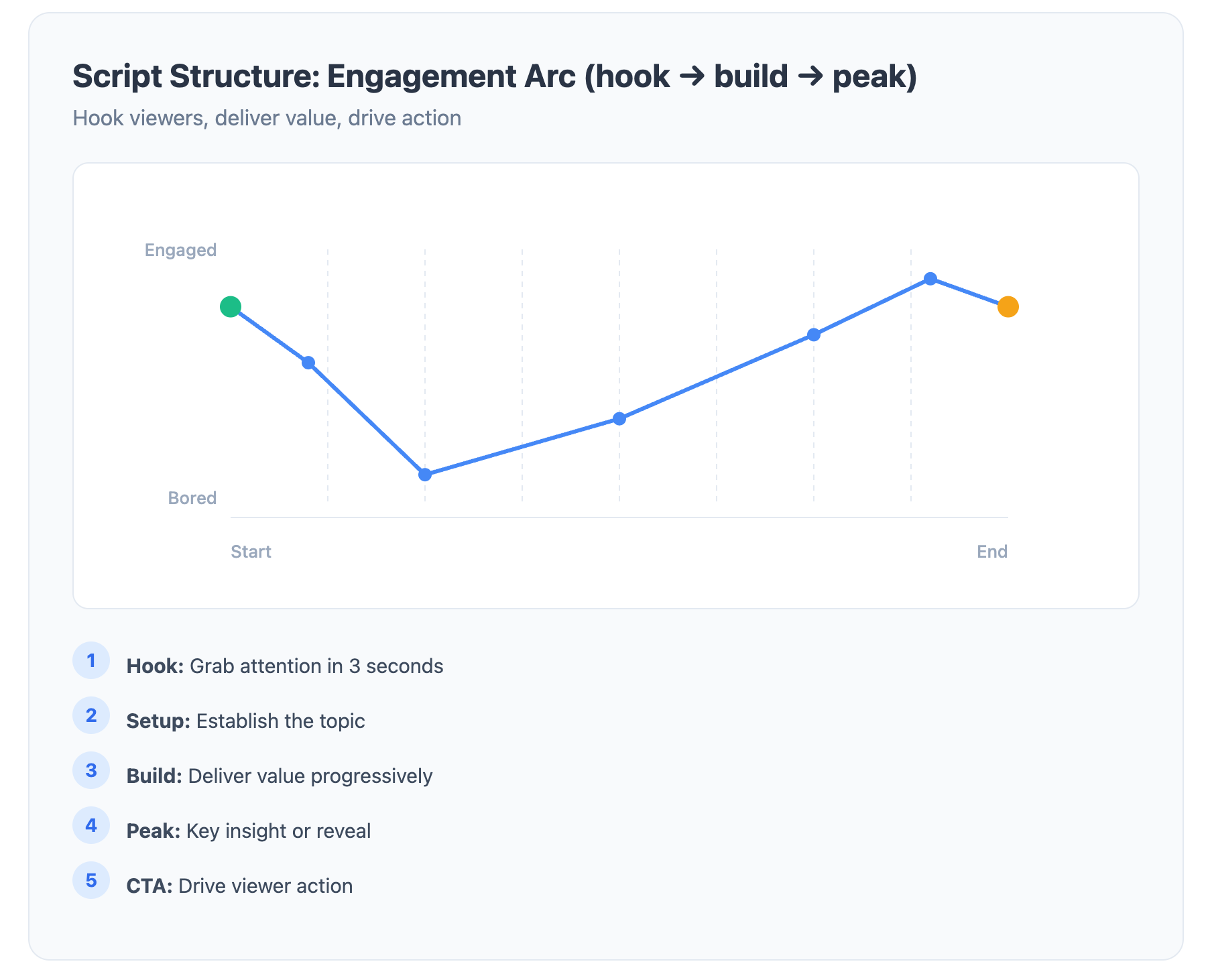
The result: scripts that don't just inform — they drive higher retention and completion rates, because the right emotional journey for your content type is baked in from the first line.