Professional script coverage costs $50 to $300 a pass and takes one to three weeks to come back. Most paid services give you a single PDF with a letter grade, a paragraph of opening thoughts, and a few notes. If you want a second opinion you pay again and wait again.
The AI alternative has its own problem. Most AI screenplay tools want to rewrite the script for you. You hand them your draft, they hand you back a "polished" version that's no longer your work. The voice flattens. The judgment calls disappear. Your script becomes a Mad Lib with a model's defaults filling the blanks.
We built something different. ScriptHooks now grades narrative work the way a studio reader does, and refuses to do anything past that.
The rule is simple. We grade. You write. The model identifies what's working and what isn't, with page numbers and specific scenes. The decisions about how to fix it stay with you.
What it does
Two tools, both built for narrative scripts (feature screenplays, short films, web series episodes, sketches, music video treatments).
Script Grade
A studio-style score. Letter grade, 0 to 100, Pass/Consider/Recommend, six screenwriter-specific axes (Opening Image, Inciting Incident, Structure, Pacing, Character Arc, Ending). Plus specific strengths and improvements with page numbers.
Reader / Coverage
Deeper structural diagnosis. Maps your script against both Comedic Structure (redemption arc) and Tragic Structure (failed or sealed arc), runs five relational rule checks per mode, and issues a verdict on which mode the script actually operates as. Includes market positioning: comparable films, budget tier, distribution targets, talent references.
The Script Grade
Type "Grade a script" in the chat, paste your screenplay, and the agent detects the format automatically. INT./EXT. headings, character cues, FADE IN markers. It picks the right rubric based on length and shape: short_film for anything under 25 pages, feature_screenplay for full features, web_series_episode for serialized work, sketch_comedy for premise-driven shorts, music_video_treatment for concept docs.
The axes are tuned for narrative craft, not social retention. Opening Image grades the very first scene's tone and world-establishment. Inciting Incident grades the disruption that forces the story to start. Structure grades three-act adherence and act-break placement. Pacing grades scene economy. Character Arc grades the protagonist's transformation. Ending grades whether the final image lands thematically.
For feature screenplays, you also get the industry standard Pass / Consider / Recommend rating, calibrated to the same distributions paid coverage services use: roughly 3% Recommend, 20% Consider, 77% Pass. Most amateur scripts land at Pass. That's the honest baseline. A Recommend means the script is sellable as-is, which is rare and should be.
The Reader
If you want more than a grade, run Reader from the same chat or click "Run Reader" on the grade card. Reader produces something called Coverage, a structural diagnosis that goes deeper than the grade.
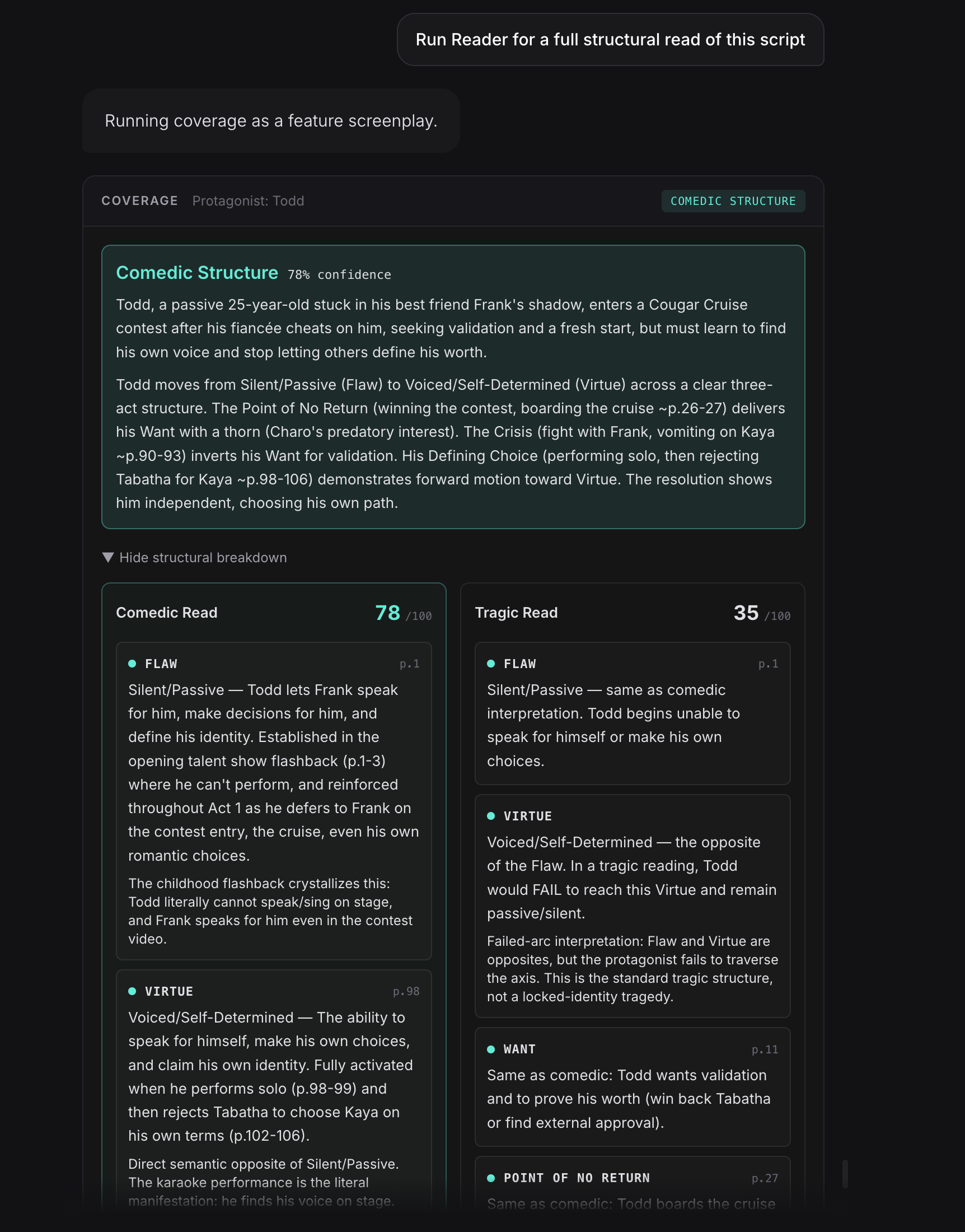
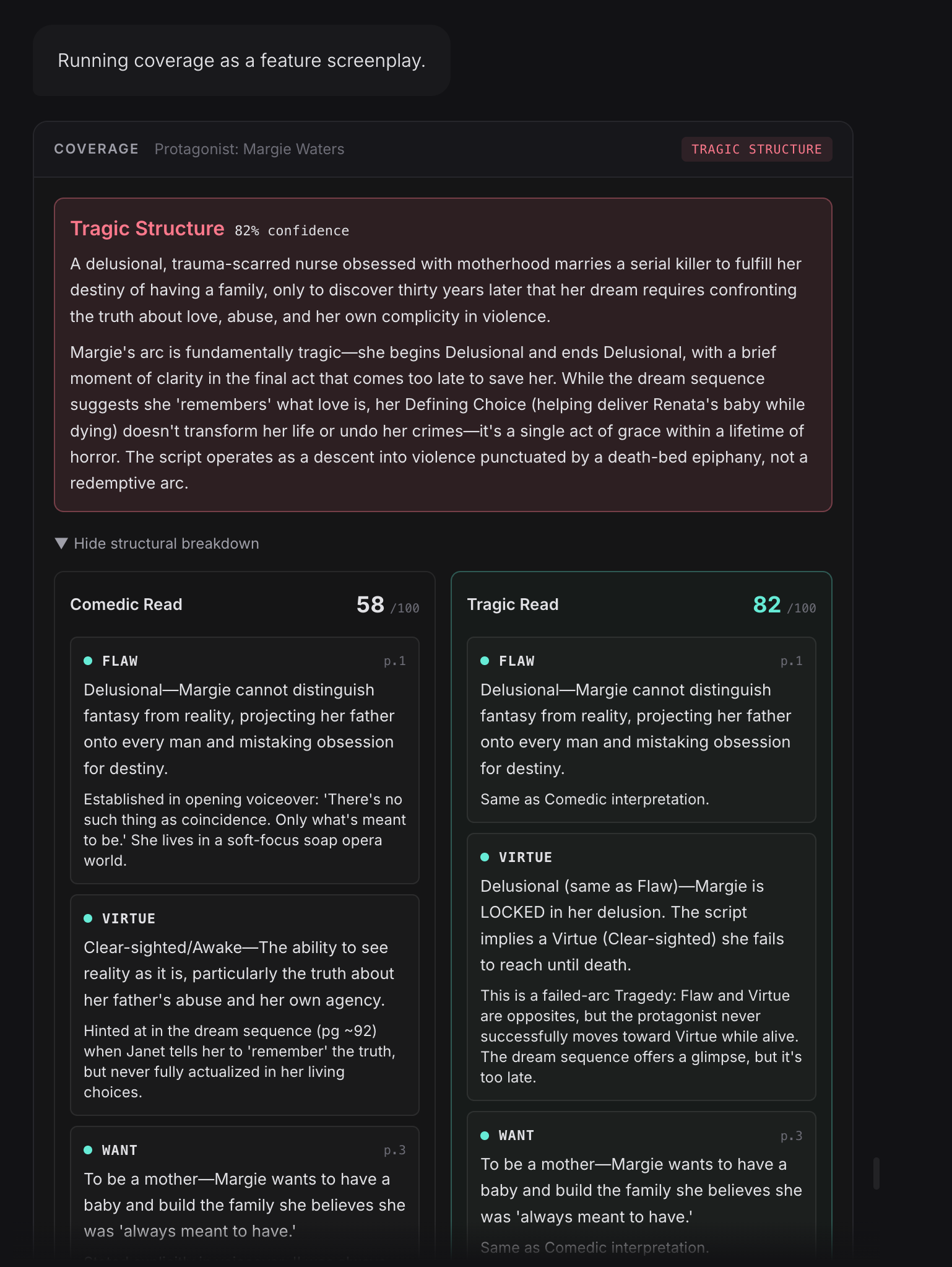
Coverage interprets your script twice, once as a Comedic Structure (the protagonist arcs from Flaw toward Virtue, a redemption story) and once as a Tragic Structure (the protagonist fails to grow, or is locked in their identity, or actively worsens their flaw). For each interpretation it identifies eight dramatic slots: Flaw, Virtue, Want, Point of No Return, False Win or False Triumph, Crisis, Defining Choice, Resolution. Then it runs five relational rule checks per mode and scores how well the script fits each one.
The verdict tells you which mode the script actually operates as. Sometimes the answer is "hybrid" when the writer is reaching for one mode but landing in the other. Sometimes it's "unresolved" when the structural spine isn't legible at all. Most amateur scripts are hybrid or unresolved. Few are clean Comedy or clean Tragedy.
Plus market positioning
At the bottom of every Coverage report, a Prospects section. This is the dimension professional readers include that most AI tools skip. Genre tags (specific ones, not just "Comedy"). Comparable works (three to five films, with year and a sentence explaining the comparison). Budget tier (micro, low, mid, studio, or tentpole) with a realistic dollar range. Distribution targets (A24, Netflix, Shudder, festival circuit, whatever fits). Talent references (directors and actors whose voice the script matches).
The comparable films are real. The talent suggestions are real people. We tell the model to omit any reference it can't ground rather than fabricate plausible-sounding ones. If a comp shows up in your Coverage, it exists.
How it empowers a writer
Coverage exists to help a writer see their script the way other people will see it. That is the entire point of having a reader at all. You wrote the thing, you know what you meant. The question is whether what you wrote on the page is what's actually getting read.
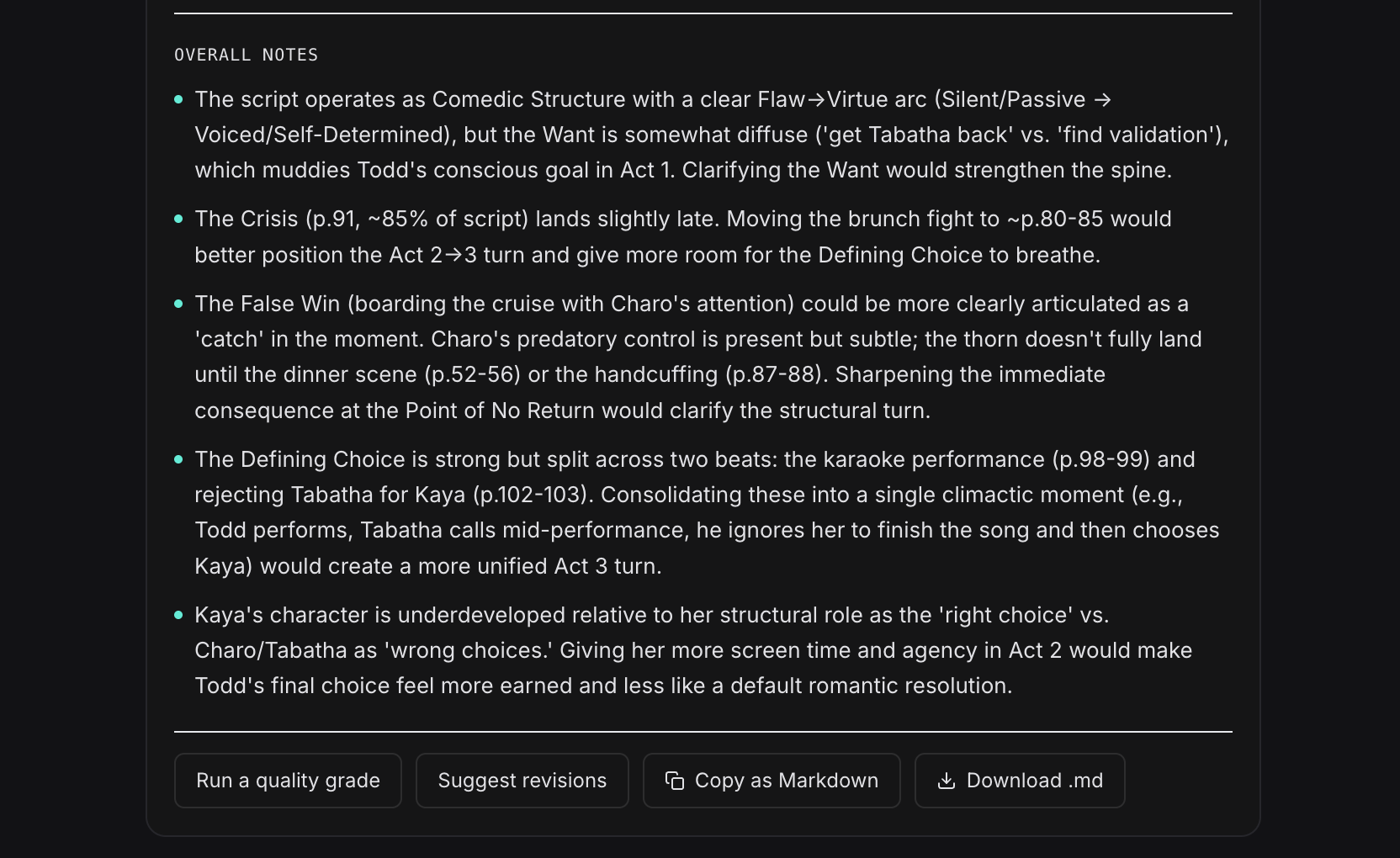
When Coverage tells you that your script's Defining Choice happens at page 95 instead of page 75, that's information about the script as it stands, not a prescription for what to write next. When it tells you the Crisis lands too late, you know there's a structural problem to solve, not what solution to apply. When it identifies the script as Tragic when you wrote it intending Comedy, that's a diagnostic, not a verdict on your taste.
Every observation is anchored to a specific page or scene. Not "the second act sags" but "pages 40 to 80 drift through episodic speed dating and spa scenes without escalating the protagonist's internal conflict." Not "weaken your antagonist" but "the False Win mechanism on page 28 is conceptually strong but underplayed in the protagonist's subjective experience."
From there you do what writers do. You consider the note. You decide whether you agree with it. You figure out the fix, in your voice, with your judgment. The reader does not get to make those calls.
Follow-up notes in chat
After a grade, you can keep talking. Ask for deeper notes on a specific axis. Ask the agent to walk through the midpoint beat by beat. Ask why the opening image scored a 4. The agent responds with written craft notes, in the chat, in plain language.
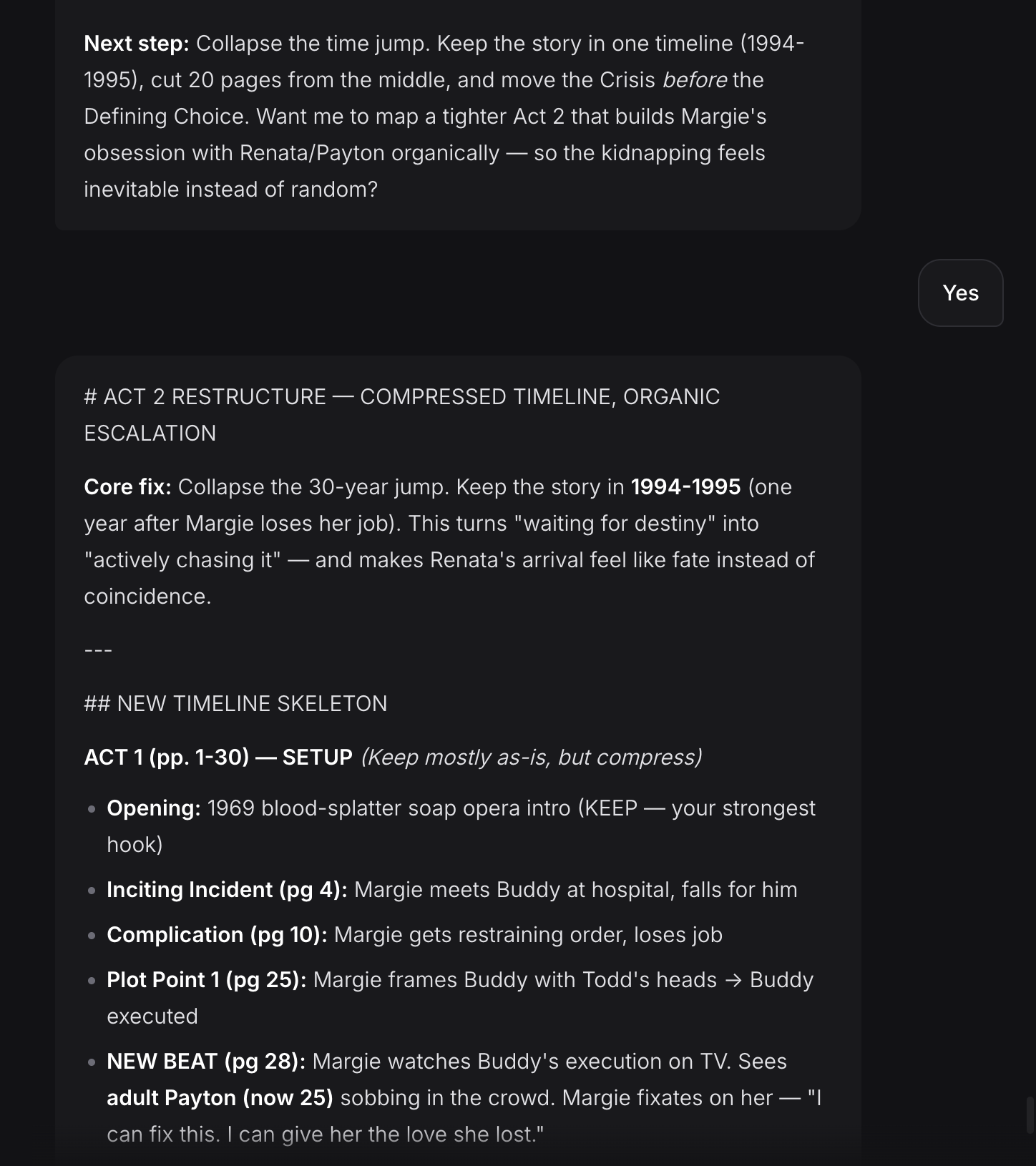
What it will not do, ever, after a narrative grade: generate a new opening, draft alternative dialogue, write you a revised scene, produce a polished rewrite, output a beat sheet as a deliverable. We've blocked all of that, deliberately, both at the prompt layer and at the response layer. If you ask the agent to "rewrite my Act 2," it will give you written analysis of how to rewrite your Act 2 yourself. The rewrite stays your work.
How a typical session goes
- Paste your screenplay into the chat. Up to 150,000 characters for a feature, about 25,000 for a short. Format is auto-detected from INT./EXT. headings and character cues.
- Get a Script Grade. Letter grade, 0 to 100, P/C/R for features, six-axis breakdown with strengths and improvements. Usually back in 30 to 60 seconds.
- Run Reader. Click "Run Reader" on the grade card or type "give me coverage on this." The full structural Coverage takes 60 to 120 seconds for a feature.
- Read the dual-mode breakdown. Compare the Comedic and Tragic interpretations. Identify which mode your script actually operates as.
- Look at the Prospects section. Real comparable films, budget tier, distribution targets, talent references. Use this to position the script when you start sending it out.
- Ask follow-up questions. "Why did the midpoint score a 4?" "Walk me through the Charo dinner restructure beat by beat." The agent answers with written craft notes, no tool generation.
- Export the Coverage. Copy as Markdown to clipboard or download as a
.mdfile. Paste into Final Draft notes, Highland, Notion, Obsidian, or convert to PDF for sharing with collaborators.
What it's calibrated against
The scoring distribution is matched to professional script reader norms. Most amateur features score in the 50 to 65 range and earn a Pass. That is the industry default, not a failure. About 20% of features get a Consider. Around 3% get a Recommend. We do not inflate scores to make writers feel better about their drafts. If your script is at 58, it's at 58, and that tells you something useful.
The comparable films in Prospects are constrained to real titles. The talent suggestions are real people whose voice fits the work. If the model isn't certain a film exists with the year it would cite, it omits the comp rather than invent one. Same for directors and actors.
The Reader uses Claude Sonnet for narrative work specifically. The reason is straightforward: Claude understands creative fiction context better than the alternatives. It handles dark comedies, addiction stories, violence, and other narrative content without misreading craft as harmful intent.
Who it's for
Working screenwriters who want a structural read between drafts. Writers preparing scripts for festivals, contests, or production. Writers who can't afford $300 every time they want a second opinion. Writers who tried other AI tools and were horrified when the tool started rewriting their dialogue.
Also useful for: producers and managers doing first-pass coverage on inbound material, story consultants comparing notes against an independent read, and anyone who wants the dual-mode comedic-versus-tragic diagnosis on a draft to figure out what the script actually is.
What it isn't
It isn't a substitute for human notes from people who know your work. A good writing partner, manager, or producer who has read multiple drafts of your script will see things our reader can't, because they know your intentions and your history. Coverage is a structural and positional read. Human notes are a relational read. Both have a place.
It isn't a script doctor. It will not improve your script by editing it. That work is yours.
It isn't a market guarantee. The Prospects section reflects the model's best read on where the script could fit. Comparable films and talent suggestions are starting points for thinking about positioning, not predictions about who will buy your work.
Try it on a draft
Open the chat, click "Grade a script," paste your screenplay. The reader is live now for every paid tier. Run Reader for the deeper structural Coverage.
Grade your screenplay →
- The ScriptHooks Team
Tools for writers who take the craft seriously.