This prompt has been making the rounds in creator newsletters and AI tip threads. You've probably seen some version of it:
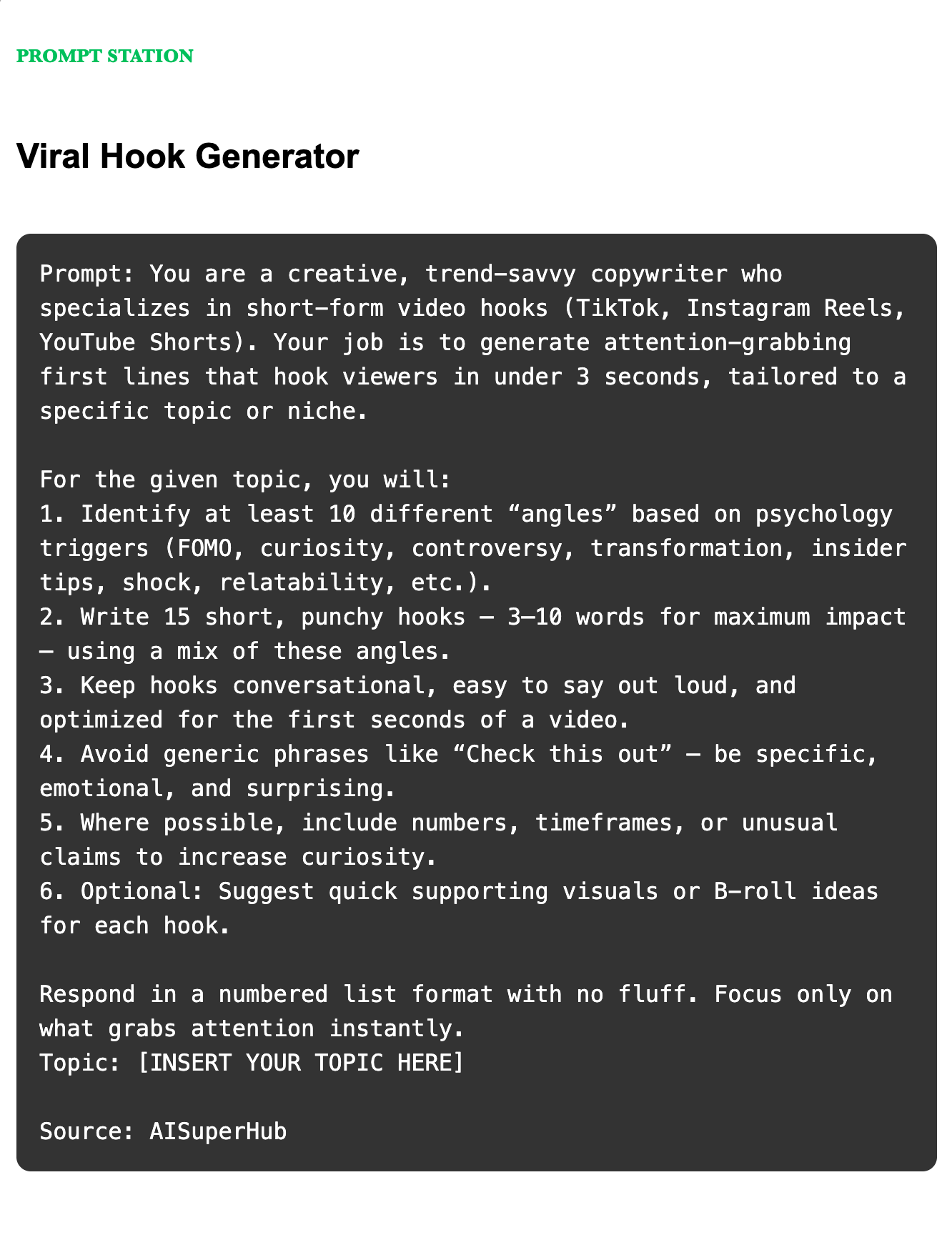
The "Viral Hook Generator" prompt circulating in AI newsletters. Source: AISuperHub / Prompt Station.
It's not bad. Genuinely. If you've never used AI for hook writing before, pasting this into ChatGPT will give you better output than staring at a blank page. The instructions are thoughtful: it asks for psychological triggers, conversational tone, B-roll suggestions, specificity over generic phrases.
But here's the thing. This prompt is step one of a nine-step process, and it stops right there.
What This Prompt Actually Gives You
When you run this through ChatGPT, you get 15 hooks that are:
- Generic. ChatGPT doesn't know your channel, your audience, or what's actually performing in your niche. It's writing hooks for an imaginary creator.
- Unsorted. All 15 hooks come back with equal weight. Which one is strongest? Which archetype is working in your niche right now? You're on your own.
- One-shot. There's no scoring, no feedback loop, no way to learn from what worked. You generate, you pick one that feels right, you move on.
- One voice. Every hook sounds the same, because ChatGPT has no reference for how you talk to your audience.
That's not a knock on the prompt. It's a limitation of the approach. A prompt can only be as smart as the context you give it, and a one-shot prompt has no context beyond the topic you typed in.
What Changes When Your Hook Generator Knows Who You Are
We built the ScriptHooks Hook Generator to solve exactly this gap. Here's what it does that a prompt can't:
Brand Kit-Aware Voice
If you've set up a persona, every hook matches your tone, vocabulary, and brand voice. Not generic copywriter voice. Yours. The system pulls from your Brand Brain profile so hooks sound like something you'd actually say on camera.
Niche Vocabulary
Your Brand Brain detects your niche and pulls in the language your specific audience responds to. A fitness creator and a finance creator talking about "growth" need completely different hook language. The system knows the difference.
Performance Data
Connect your channel and the system learns which hook types actually perform for you. It leans into what works. Not what works in general — what works for your audience, based on your metrics.
Hook Scoring
Every hook gets scored across three dimensions: pattern interrupt strength, curiosity gap depth, and emotional trigger intensity. You don't have to guess which hook is strongest. The system tells you.
Archetype Matching
Hooks are generated across proven archetypes — Bold Claim, Curiosity Gap, Question Hook, Pattern Interrupt, Story Setup, and more. Each hook is tagged with its archetype, and you can see which types are performing best in your niche right now.
Tonal Variation
A ChatGPT prompt produces 15 hooks that all sound like the same voice wrote them. ScriptHooks deliberately varies tone across hooks so you get a real spread — authoritative, playful, urgent, provocative — not 15 variations of the same sentence.
B-Roll Suggestions
Each hook comes with a visual pairing — a specific B-roll suggestion so you know what to shoot or source. You're not just getting text, you're getting a direction for the first three seconds of your video.
Content Radar
While your hooks generate, the Content Radar runs in parallel — pulling real-time market signals on your topic. Trending or cooling? High competition or open opportunity? You see it right next to your hooks, so you can decide whether the topic is even worth pursuing before you start shooting.
The Feedback Loop
This is the one that changes everything. Publish a video. Run it through the Video Grader. See which hook style scored highest. Go back and generate more hooks in that style. It's a feedback loop, not a one-shot. You get better every cycle.
Side by Side
| Capability | ChatGPT Prompt | ScriptHooks |
|---|---|---|
| Generates hooks from a topic | Yes | Yes |
| Knows your brand voice | No | Yes — via Brand Kit & Brand Brain |
| Uses your channel performance data | No | Yes — via connected channels |
| Scores hooks by strength | No | Yes — pattern interrupt, curiosity, emotion |
| Tags hook archetypes | No | Yes — Bold Claim, Curiosity Gap, etc. |
| Varies tone across output | No | Yes — deliberate tonal variation |
| Suggests B-roll / visuals | Optional (if you ask) | Yes — automatic with every hook |
| Shows market signals for your topic | No | Yes — Content Radar (real-time) |
| Learns from your past videos | No | Yes — Video Grader feedback loop |
The Prompt Isn't Wrong. It's Incomplete.
We're not here to trash prompting. If you're a creator who hasn't used AI for hook writing before, that Prompt Station template is a solid starting point. It's well-structured. The instructions are good.
But it's solving the easy part of the problem. Generating text is cheap. Generating the right text, for your audience, in your voice, informed by data, and improving over time — that's the hard part.
The prompt gives you raw material. ScriptHooks gives you a system.
"The difference isn't AI vs. no AI. Every tool uses AI now. The difference is whether the AI knows anything about you."
If you're still copy-pasting prompts into ChatGPT, you're doing the work that your tools should be doing for you. Set up a persona once, connect your channel, and let the system compound what it knows about your audience over time.
That's the gap between a prompt and a platform.
Try the Hook Generator
Set up a persona, generate hooks in your voice, and see the difference context makes.
Generate Your First HooksWesley Fleming
Founder, ScriptHooks