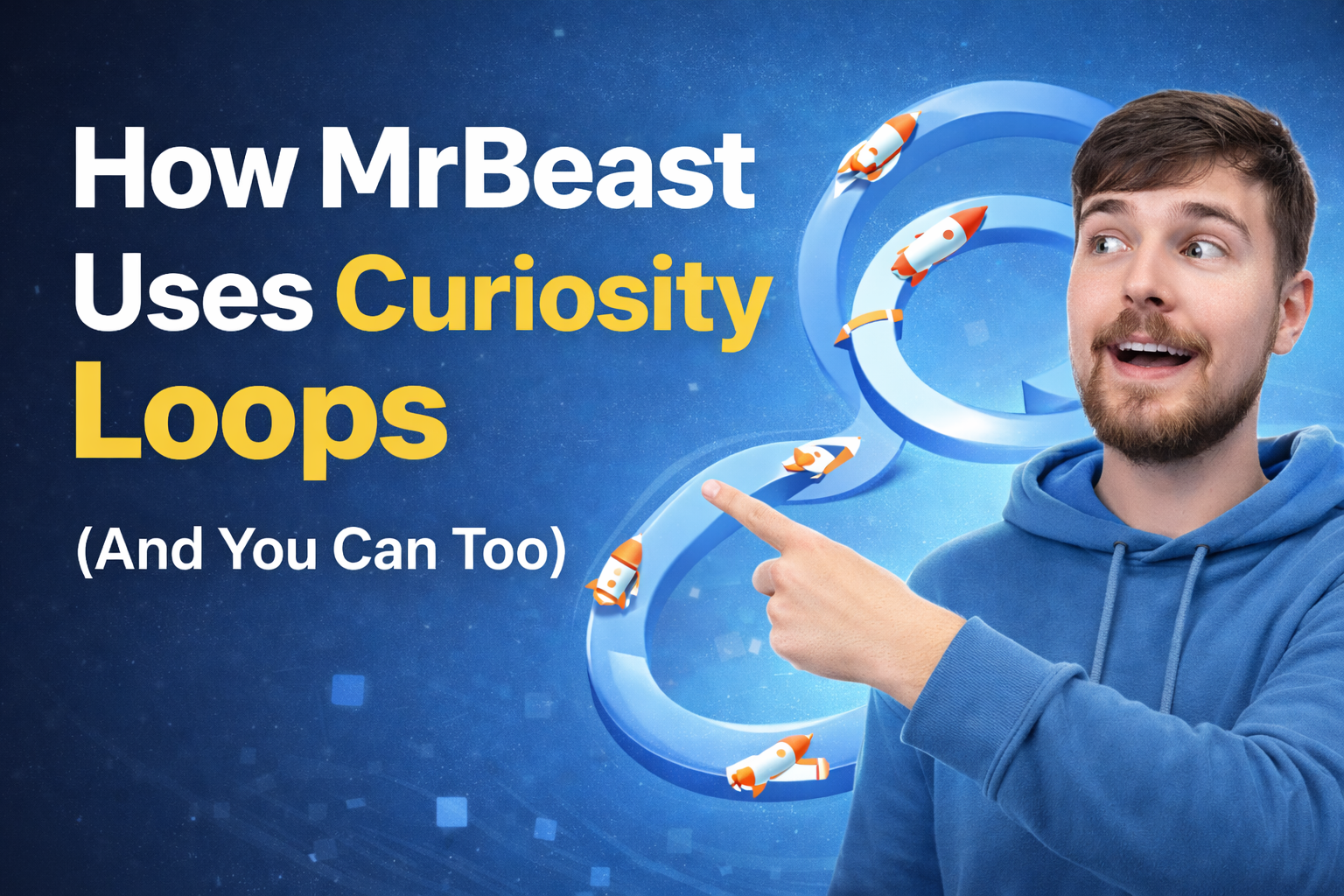
According to one analysis of MrBeast's retention data, a typical video loses millions of viewers in the first 60 seconds alone.
That's not a failure—that's actually above average for YouTube. The platform is brutal. Attention is measured in seconds, not minutes, and the difference between a video that gets 10 million views and one that gets 100 million often comes down to how well you keep people watching.
MrBeast knows this better than anyone. In a leaked 36-page internal document titled "How to Succeed in MrBeast Production," he revealed the exact system his team uses to engineer retention. At the core of that system is a technique as old as storytelling itself, weaponized for the algorithmic age: curiosity loops.
Here's how it works—and how you can use it too.
What Is a Curiosity Loop?
A curiosity loop (sometimes called an "open loop") is an unresolved question or tension that keeps your brain engaged until it gets an answer. It's the psychological equivalent of an itch you can't scratch.
The science behind it is called the Zeigarnik effect, named after psychologist Bluma Zeigarnik, who noticed that waiters could remember unpaid orders far better than paid ones. Once a task feels "closed," our brains move on. But when something remains unresolved, it occupies mental real estate until we get closure.
This is why cliffhangers work. It's why you binge-watch shows. And it's why MrBeast's videos keep people watching when most creators lose them in the first minute.
The MrBeast Retention Framework
MrBeast doesn't leave retention to chance. His leaked production document reveals a minute-by-minute framework for structuring videos. Every segment has a purpose, and curiosity loops are embedded throughout.
The First Minute: Open the Loop Hard
The leaked production document states that the first minute is where "retention is either won or lost." The directive to his team: front-load information while matching the expectations set by the thumbnail and title.
But here's the key—you're not resolving anything yet. You're opening loops. You're showing viewers what's at stake without telling them how it ends.
In his "$1 vs $1,000,000,000 Yacht" video, the first seconds establish the premise and show glimpses of increasingly insane boats. The loop is open: how extravagant does this get? You have to keep watching to find out.
Minutes 1-3: Crazy Progression
MrBeast uses a technique he calls "crazy progression." Instead of telling a story linearly, he compresses time to create momentum.
This creates what we might call a progress loop—viewers have already invested in the journey and want to see the destination.
The 3-Minute Re-engagement
Around minute 3, MrBeast's team intentionally inserts what he calls a "re-engagement"—something impressive or unexpected that snaps viewers back to attention just as they might be getting bored.
MrBeast's Definition of Re-engagement:
"A re-engagement can be described as content that is highly interesting, fits the story, and makes people genuinely impressed. Another way to look at this is it's a segment that 'only MrBeast can do.'"
A concrete example: In the "$10,000 Every Day You Survive Prison" video, there's a moment around the 3-minute mark where Karl is put in charge of watching Josh. It's unexpected, it fits the story, and it opens a new curiosity loop: what's Karl going to do with this power?
Minutes 3-6: Stack the Loops
MrBeast describes minutes 3-6 as needing "the most exciting and interesting content that is also very simple." This includes "lots of quick scene changes and highly stimulating simple content that reflects the story."
The goal here is to get viewers emotionally invested in the people and the outcome. You're not just maintaining one curiosity loop—you're stacking multiple smaller loops within the larger narrative.
The 6-Minute Re-engagement and Beyond
Another re-engagement hits around minute 6, giving viewers "a reason to continue watching" through the back half. By this point, if you've done your job, viewers are committed. But MrBeast warns against coasting: "The second half should be just as engaging as the first half."
Analysts suggest MrBeast videos are engineered with multiple retention peaks—dopamine hits strategically placed throughout the runtime.
The Micro-Hook System
Beyond the structural framework, observers have noted that MrBeast's team plants what some call "micro-hooks" throughout videos—small, verbal curiosity loops that keep viewers leaning in.
If you watch his videos closely, you'll hear phrases like:
- "And that's not even the crazy part..."
- "But wait, it gets better..."
- "You won't believe what happens next..."
- "In just a minute, I'm going to show you..."
Each of these opens a small loop that demands closure. Scattered throughout the video, they constantly renew the viewer's commitment to keep watching.
One content strategist observed that MrBeast appears to hint at the end-of-video payoff every 5-10 minutes, creating what they described as an open loop in the viewer's mind that can only be closed by watching until the end.
The Payoff Principle
Curiosity loops only work if you eventually close them. MrBeast is explicit about this: the ending matters.
His "last to leave" format is a masterclass in payoff structure. The leaked document explains the psychology: "Once you start watching a 'last to leave,' you get invested in the progress and the challenge. You really want to see who leaves the circle last and wins the $100,000. Luckily the winner isn't revealed until the end of the video, so as long as we don't make the video boring as hell, people are very likely to stick around until the end."
The format itself is a curiosity loop. The escalating stakes ("$1 vs $1,000,000,000") are a curiosity loop. The promise of seeing who wins is a curiosity loop. They all resolve at the end, delivering the dopamine hit viewers have been waiting for.
But here's a crucial insight from the document: the team avoids signaling that the end is coming. The guidance is to end abruptly and keep energy high until the final moment. If viewers sense the payoff is imminent, they might click away before it arrives.
How You Can Use Curiosity Loops (Without a Billion-Dollar Budget)
You don't need to lift a house with a crane or give away $500,000 to use curiosity loops effectively. Here's how to apply the principles at any scale:
1. Open a Loop in the First 10 Seconds
Your hook should create an unresolved question. Not "In this video, I'll show you how to..." but "There's a mistake 90% of creators make, and I'm going to show you how to fix it." The first is a promise. The second is a loop.
Strong loop-opening hooks include: questions that demand answers, surprising facts that need explanation, conflict or tension that needs resolution, and previews of a transformation or outcome.
2. Use "Crazy Progression" to Build Investment
Don't build slowly. Compress your narrative so viewers see meaningful progress quickly. If you're documenting a 30-day challenge, show highlights from the first week in the first two minutes. Get viewers invested in the outcome before they have a chance to click away.
3. Plant Re-engagement Moments
Map out your video in 3-minute chunks. At each transition, ask: "What can I do here that will surprise viewers or open a new loop?" It doesn't have to be expensive. A twist in the story, an unexpected guest, a reveal of new information—anything that makes viewers think "wait, what?"
4. Scatter Micro-Hooks Throughout
Verbally tease what's coming. "In a minute, I'll show you the part that changed everything." "But the real surprise comes later." "This is nothing compared to what's next." Each micro-hook renews the viewer's commitment to keep watching.
5. Deliver a Satisfying Payoff
Every loop you open must close. If you promise a reveal, deliver it. If you set up a question, answer it. Broken loops destroy trust and train your audience to stop believing your hooks.
6. Study Your Retention Graphs
MrBeast's team obsesses over retention data. Every dip in the graph represents viewers clicking away—and an opportunity to improve. Where are people leaving? What were you doing at that moment? Can you add a loop or re-engagement at that timestamp in future videos?
The leaked document emphasizes obsessing over retention graphs—every dip represents viewers clicking away and an opportunity to improve.
The Real Secret: It Starts with the Hook
Here's what most creators miss: curiosity loops don't start at minute 3. They start before anyone clicks play.
Your thumbnail and title are the first loop. They create curiosity that can only be satisfied by watching. MrBeast's team tests multiple thumbnail and title variations before every video, measuring which combinations generate the most curiosity (measured by click-through rate).
The production document is explicit: "Your title and thumbnail must create curiosity (and extremely so)." The first frame of your video should confirm that curiosity was justified—and immediately open the next loop.
This is why your opening hook matters so much. It's the bridge between the curiosity that got someone to click and the curiosity that will keep them watching. A weak hook breaks the chain. A strong hook extends it.
The Bottom Line
MrBeast didn't stumble into 300+ million subscribers. By his own account, he spent years studying what makes people watch, developed a systematic approach to engineering retention, and documented it precisely enough that his team can execute it consistently.
Curiosity loops are at the heart of that system. They're not manipulation—they're good storytelling, optimized for a platform where attention is the only currency that matters.
The framework is learnable: open loops early, stack them throughout, re-engage at predictable intervals, scatter micro-hooks, and deliver satisfying payoffs. The creators who master this will be the ones who thrive as attention becomes ever more scarce.
Start with the hook. Everything else follows from there.
Find Hooks That Open Curiosity Loops
ScriptHooks.ai helps you find viral hooks that open curiosity loops from the start. Our database of 5,000+ proven hooks from videos with 100K-165M views gives you a head start on the most important part of your video.
Find Your Next Hook →
— Wesley Fleming
Founder, ScriptHooks.ai
P.S. - Want more content strategy insights like this? We send exclusive breakdowns to our newsletter subscribers every week. Sign up here.