Ask ChatGPT, Perplexity, or Google's AI mode who the best tools or voices are in your category. The answer either names you or it does not. There is no page two, no ten blue links to scroll past. For a fast-growing share of your audience, that one answer is the entire shelf.
We have been running AI visibility audits: asking the major AI engines the real questions buyers and audiences ask, several times each, and measuring who gets named, who gets cited, and where the answers actually come from. A few findings came back that are worth your time whether you run a brand or build an audience.
AI answers are built from content you do not own
The most consistent thing we saw: the answer an engine gives is assembled almost entirely from third-party sources. Review sites, community threads, editorial, and creator content. Not your website.
In one representative audit we ran, the brand's own pages accounted for under 5 percent of cited sources. Independent research and industry audits consistently show the same shape: brand-owned sites are only a small fraction of AI search sources, with the majority coming from third-party content. Whoever controls those third-party surfaces controls the answer, and that is rarely the brand itself.
Brands: you are probably losing, and you cannot see it
In one full audit of a B2B software brand in a crowded category, it scored 26 out of 100 on the buyer questions in its own space. It was tied with two competitors for share of voice, not ahead of them. And on the unbranded discovery questions, the ones a new buyer types before they know any brand names, it showed up in about one answer in eight.
That brand was not careless. This is the normal state of things, and that is the point: a sophisticated, well-resourced company still could not see its own position until it was measured. Your AI visibility is not your search ranking, not your follower count, and not your gut sense of how strong your brand is. It is its own number. It moves on its own. And almost nobody is watching it.
Creators: AI can know you and still not cite you
For creators the finding was sharper. We looked at a creator with a strong professional reputation. Asked directly who she was, every engine answered correctly and in detail. But her actual content, the videos and the newsletter, barely showed up in answers, because most of it lived on platforms the engines do not pull from, published under project names rather than her own.
Those are two different things, and you need both. There is AI knowing who you are, which is built from press, bios, podcasts, and the open web. And there is AI citing your content, which only happens on the surfaces engines actually read, in formats they can extract. A creator can be well known and uncitable at the same time.
Citation power is also not the same as reach. Across our audits, the creators the engines cite most in a category are often not the biggest accounts. Some have a few thousand followers. Engines pick content by how extractable and trusted it is, not by audience size. That means a brand can earn its way into AI answers far more cheaply than it can buy reach, and a small creator can out-rank a large one where it counts.
The brands and the creators are the same story
Here is why this matters for both at once. Brands win AI search largely through third-party content other people make, and a lot of that is creator content. Creators build durable audience by being the content AI trusts to answer the question. The brand needs the creator to be citable. The creator needs to be citable to be valuable. They are two ends of the same pipe, and right now most of the money flowing through it is measured against views and engagement, not against whether any of it surfaces when an AI answers the question.
One more thing worth knowing: the engines disagree with each other. The same brand or person can look materially different on ChatGPT than on Google's AI mode than on Perplexity. There is no single AI search ranking to chase. There is a per-engine, per-question map, and the only way to know yours is to look at it.
We ran it on ourselves first
Before we put this in front of anyone else, we pointed it at ScriptHooks. We had work to do, and here is exactly what we found.
Our own brand scored 17 out of 100. On the unbranded discovery questions in our category, the ones a creator types before they know any tool names, we showed up less than 1 percent of the time. The honest read: when someone asks an AI engine for the best tools in our space, it does not yet know to say us. A low score is not a verdict on the product. It is the starting diagnosis, the same one we are offering you.
The more useful half of the report is the shortlist. These are the creators the engines actually cite in our category, ranked by how often they show up in answers:
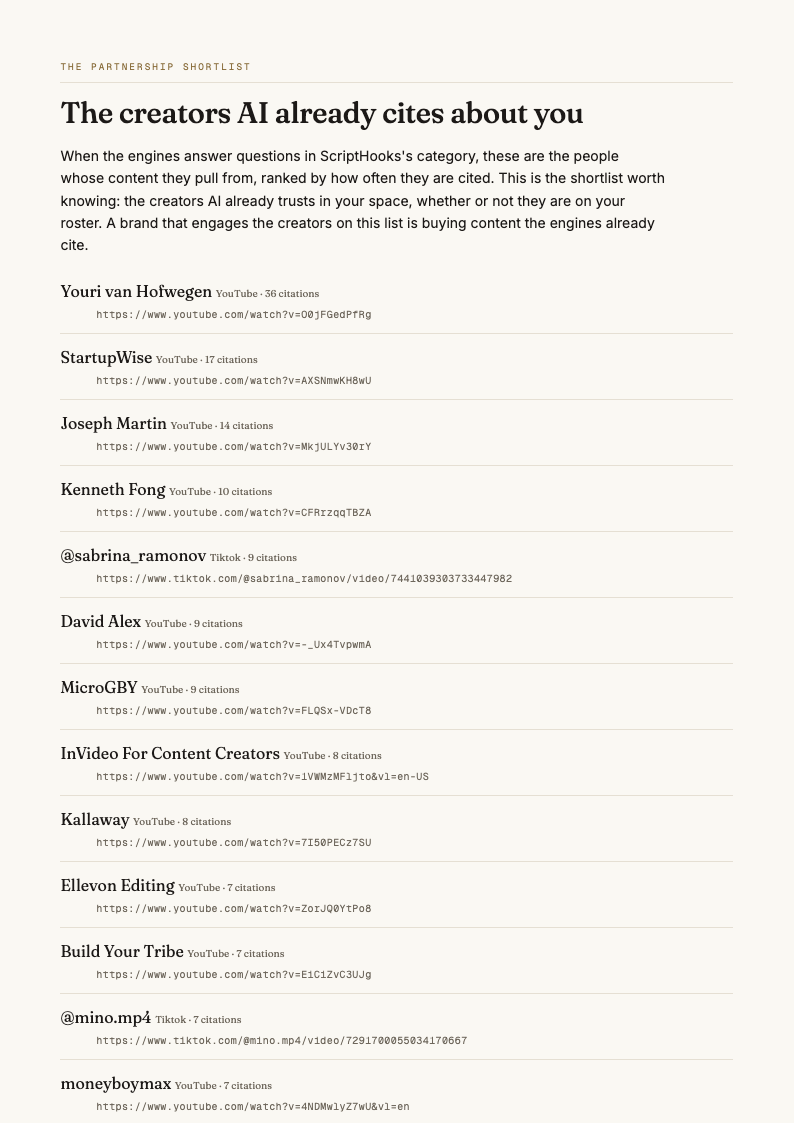
The creators AI already cites in our category, ranked by citation count. None of them are us.
None of them are us. Several have a few thousand followers. Every name on that list is a place our category's answers are being assembled, and a place we were not. That is not a scoreboard to feel bad about. It is a to-do list, and now we have it.
See where you stand
All of this stays invisible until you measure it, which is the whole problem. The answer is already being given, dozens of times a day, in rooms you are not in.
If you make content and you have never seen your own AI footprint, that is the first thing worth doing. ScriptHooks can show you: point it at a brand or a creator and it maps, engine by engine and question by question, where AI sees you, where it does not, and who it names in your place. Then it helps you make the content that changes the answer.
Find out if you're in the answer
The engines are naming names in your category dozens of times a day. Right now you cannot see whether one of them is yours, and every day the answer hardens around someone else. It takes about three minutes to find out where you stand.
Check your AI footprint →Already on ScriptHooks Pro? Run yours right now.
Running a brand, not a personal channel? Book an AI visibility audit →
- Wes Fleming
ScriptHooks